Not a denomination, but Christian
I'm not a Calvinist, Baptist, Lutheran, Presbyterian, or an Arminian; I'm a Christian.
11/12/20255 min read

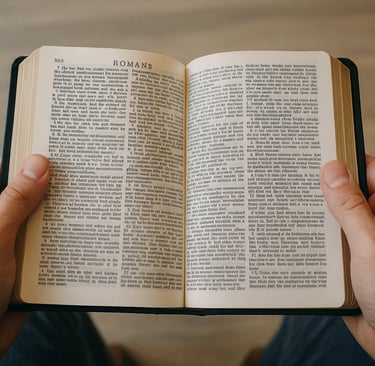
“I appeal to you, brothers and sisters, in the name of our Lord Jesus Christ, that all of you agree with one another in what you say and that there be no divisions among you, but that you be perfectly united in mind and thought. My brothers and sisters, some from Chloe’s household have informed me that there are quarrels among you. What I mean is this: One of you says, ‘I follow Paul’; another, ‘I follow Apollos’; another, ‘I follow Cephas’; still another, ‘I follow Christ.’
Is Christ divided? Was Paul crucified for you? Were you baptized in the name of Paul? I thank God that I did not baptize any of you except Crispus and Gaius, so no one can say that you were baptized in my name.
Where is the wise person? Where is the teacher of the law? Where is the philosopher of this age? Has not God made foolish the wisdom of the world? For since in the wisdom of God the world through its wisdom did not know him, God was pleased through the foolishness of what was preached to save those who believe.”
1 Corinthians 1:10-13;20-21
These verses from the Apostle Paul are no less relevant today than they were when he wrote to the Corinthians, who appear to have developed their theology based on people’s interpretations of Scripture. Nowadays, we face the same issues that Paul preached against. Calvinists, Arminians, Lutherans, Presbyterians, Baptists, and so many others are fighting for their right interpretation, where we should all preach Christ crucified. I wrote an article against Calvinism, but then I realized that actually nobody is right. Not Arminians, not Calvinists, not Baptists. We all fall short in understanding God’s sovereignty and human free will. We can read the Bible and see clearly that we are responsible for our sins, and therefore God doesn’t make us do evil, because God is love and not a tyrant. We also see that God numbers all the hair on our heads. Then you read “I form the light and create darkness, I make peace and create evil: I the LORD do all these things" (Isa 45:7) and also “They have built the high places of Topheth in the Valley of Ben Hinnom to burn their sons and daughters in the fire—something I did not command, nor did it enter my mind.” (Jer 7:31). Then, “would you wait until they grew up? Would you remain unmarried for them? No, my daughters. It is more bitter for me than for you, because the Lord’s hand has turned against me! (…) ‘Don’t call me Naomi,’ she told them. ‘Call me Mara, because the Almighty has made my life very bitter’” (Ruth 1:13;20) but also “if at any time I announce that a nation or kingdom is to be uprooted, torn down and destroyed, and if that nation I warned repents of its evil, then I will relent and not inflict on it the disaster I had planned.” (Jer 18:7-8). At least 40 Bible verses tell about God’s refrain.
As Richard F. Vieth put it in his book “Holy Power, Human Pain”, we as Christians are trapped in a dilemma about the incompatibility of God and evil:
“Believers are trapped in a dilemma. If they seek an explanation for the apparent incompatibility of God and evil, then it seems that they are trying to take heaven by storm. Yet if they rest their case in mystery, they run the risk of naive credulity, or even of believing self-contradictory nonsense.
There really is no escape from this predicament, so we must be content with trying to ‘muddle through,’ as the British so aptly put it. There are no final answers, but surely some answers are better than others. So we seek the best answers we can find, all the while acknowledging the circumambient mystery.”
Dr. D. A. Carson, in his book “How Long, O Lord?” thinks Vieth is right, that there is no harm in trying to resolve the mystery. I disagree. The harm is there for everyone to see. Hundreds of divisions, and nobody agrees on anything anymore. We forgot the basics, and with that, our love grew cold. We went too far on things that don’t matter. Who cares if the rapture will actually happen, for instance? Or who cares about dispensationalism? Why is this important anyway? Who are we to say God must do this or must do that? What is the Bible message as a whole anyway? What we should preach is Christ crucified, and that He died for us. Luther didn’t die for you, nor Calvin or Arminius. Why so vehemently defend your dogmatics? What do you want to prove? Are you trying to defend God? Can you do that anyway?
No, you cannot. I’m not saying we should behave as if everything goes, of course not, but to follow the basic principles of the Bible: Christ died for you. Repent! Obey Jesus in everything He teaches us to do. That’s it. Are you focusing on the basics, or are you wasting your time in endless debates that do not glorify God in any way? Are you trying to glorify yourself? Perhaps you are.
The bottom line, as we fall short, is this: Any attempt to understand God’s creation and God’s mind will ultimately fail. That’s why so many debates. The sides are right, from their perspectives. Yes, the Bible supports many sides. As Dr. D. A. Carson attempts to explain in the book above, there is a compatibility between the two views that God is sovereign and people have free will. I ask the question: How so? Where is the truth in this conundrum? Can an ant understand calculus? Can a bee elaborate on the traveling salesman problem? Can a worm understand quantum physics? That’s what we’re trying to do, and with that, separating, dividing, trying to prove that one is more right than the other, and forgetting the love we are supposed to give to each other. Calvinists simply ignore basic Bible verses to prove their point, with an hourglass to (very) specific verses, forgetting many others like 1 Timothy 2:3–4; 2 Peter 3:9; John 3:16; Romans 10:13; Matthew 23:37; Isaiah 1:18–20; John 5:40; Acts 17:30; Romans 2:4; 1 John 2:2; 1 Timothy 2:6; Hebrews 6:4-6, Acts 7:51, 2 Peter 2:20–22, and many, many others.
On the other hand, Arminians invented the self-limiting God, undermining his absolute sovereignty. Molinism posits intricate mechanisms of middle knowledge, portraying God as a chess player and placing people in situations where He knows their actions, and also limiting their Bible verses to 1 Samuel 23:6-14 and Matthew 11:21-24 to support this idea. It’s all valid from a Bible perspective and human interpretation, but is this the truth? Again, how can you tell? Can we just ignore some verses we don’t like and clearly contradict our dogmatics in favor of others? Can we invent our own god? Like the Pharisees, we are creating and shaping a new god entity by ignoring verses that don’t fit into our view, and extending others to say things the Bible explicitly doesn’t say. Calvinists invented their sadistic god. Arminians invented their self-limited god. Molinists invented a chess-playing god, and so on. But what about pick up your cross and die? How many are preaching that? What about loving our neighbors? Are you doing this? How so? Who saw your life and came to Christ because they saw a reflection of Jesus in you? How many did that?
I urge you to adhere to the Bible, identifying yourself not as a Calvinist, Baptist, Lutheran, Presbyterian, or an Arminian, but as a Christian. That’s what we all need to be, not from Paul’s or Apollo’s but from Jesus Christ, Who died for you.
Contact
Subscribe
hello@livingbyscripture.com
© 2025. All rights reserved.